Can You Rank Faster Using Long-Tail Keywords?
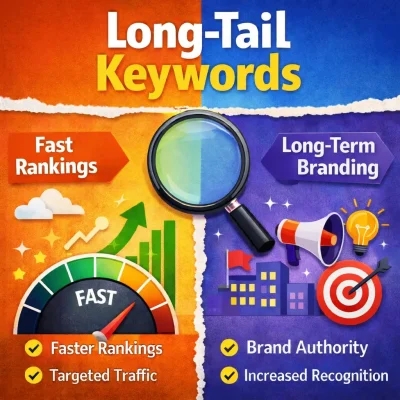
Yes, long-tail keywords allow websites to rank faster because they have lower competition and clearer search intent. Search engines can easily understand the purpose of the page, which helps new or low-authority websites gain visibility in a shorter time frame.
For many niche keywords, rankings can appear within a few weeks when the content is well optimized and properly indexed.
Short-Term Benefits of Long-Tail Keywords
Long-tail keywords offer strong short-term advantages, especially for new websites and personal brands.
- Faster search engine rankings
- High-intent visitors
- Better conversion rates
- Ideal for SEO experiments and proof of results
These benefits make long-tail keywords effective for generating early traffic and enquiries.
Drawbacks of Long-Tail Keywords for Long-Term Branding
While long-tail keywords help with quick wins, they have limited impact on long-term brand building.
Because these keywords are very specific, they:
- Reach a smaller audience
- Generate limited brand recall
- Do not position the brand as an industry authority
Users often remember the solution they found rather than the brand that provided it. Relying only on long-tail keywords can slow overall brand recognition.
How Long-Tail Keywords Affect Website Traffic
Even when ranking in the top position, long-tail keywords usually generate low traffic volume.
In most cases:
- A single long-tail page attracts 10–100 visitors per month
- Highly niche keywords may bring even less traffic
- Traffic quality is high, but scale is limited
This makes long-tail keywords better for conversions than for large traffic growth.
Why Long-Tail Keywords Alone Are Not Enough
To grow traffic and brand authority, businesses need more than just long-tail keywords.
Depending only on them can lead to:
- Slow traffic growth
- Limited audience reach
- Difficulty competing for broader keywords later
Long-tail keywords should support a wider SEO strategy rather than replace it.
How to Balance Fast Rankings and Long-Term SEO Growth
The most effective SEO approach combines quick wins with long-term planning.
A balanced strategy includes:
- Using long-tail keywords for early traction
- Building topical authority through related content
- Targeting mid and high-competition keywords over time
- Strengthening branded searches
This ensures consistent growth without sacrificing brand visibility.
Final Conclusion
Long-tail keywords are powerful for ranking faster and attracting high-intent users. However, their impact on traffic and branding is limited when used alone.
For sustainable growth, long-tail keywords should be treated as a starting point—helping websites gain early momentum while building toward stronger brand authority and higher-volume keywords.